Workforce Absenteeism Prediction Platform (Azure Fabric)
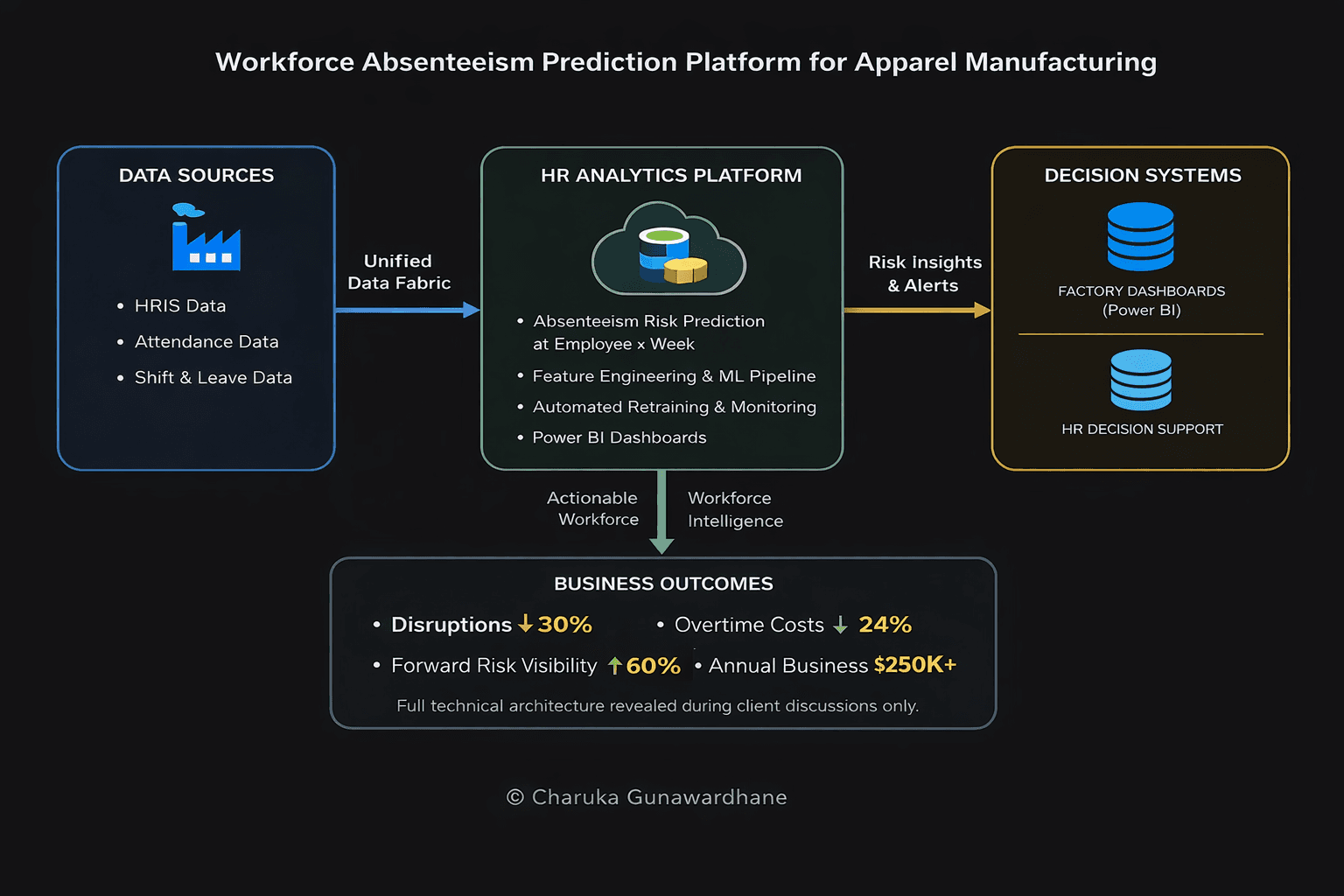
Designed and deployed a production-grade workforce absenteeism prediction system on Azure Fabric, enabling proactive workforce planning through weekly employee-level risk forecasting and decision intelligence dashboards.
1The Problem
A large apparel manufacturing organization relied on reactive reporting to manage absenteeism, leading to production disruptions, overtime costs, and inefficient workforce planning. Key challenges: - No forward-looking absenteeism insights - Manual and lagging reporting processes - Inability to link absenteeism to behavioral and operational drivers - Production inefficiencies due to unexpected workforce shortages This resulted in missed production targets, line imbalances, and increased operational costs.
2The Approach
I designed a batch-based decision intelligence system that predicts absenteeism risk at an employee × week level and integrates directly into workforce planning workflows. Key decisions: - Frame the problem as probabilistic risk prediction instead of binary classification - Use a global XGBoost model to capture shared patterns across employees - Implement medallion architecture (bronze → silver → gold) for scalable data modeling - Align prediction cadence with weekly production planning cycles - Integrate predictions directly into Power BI dashboards for decision-making
Technical Architecture
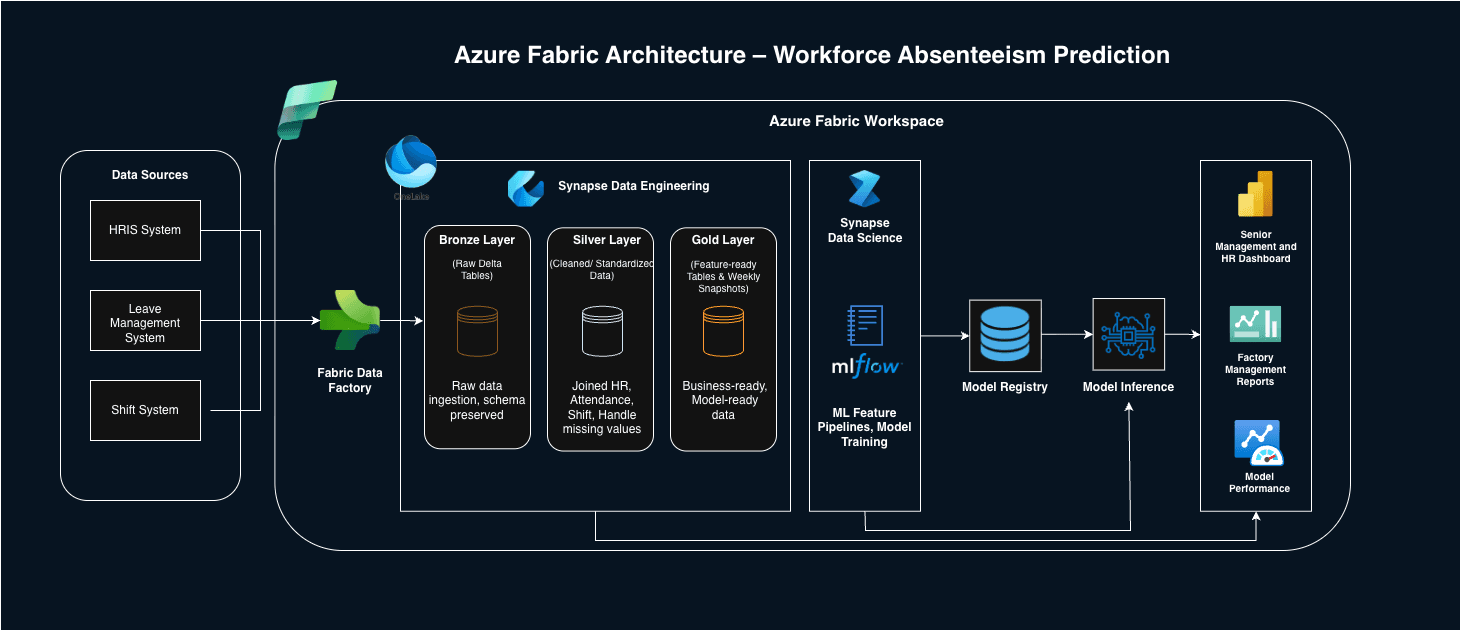
Data Sources: HRIS, attendance, leave, and shift systems
Data Ingestion: Azure Fabric Data Factory pipelines into OneLake
Data Modeling: Lakehouse architecture (Bronze → Silver → Gold layers)
Feature Engineering: Fabric Notebooks generating behavioral and temporal features
ML Training: XGBoost models trained within Fabric notebooks
Model Management: Versioning and governance within Fabric workspace
Batch Inference: Weekly prediction pipelines generating employee-level risk scores
Consumption Layer: Power BI dashboards for HR, factory leadership, and management
Monitoring Layer: Model performance tracking and workforce impact analysis
Results
Enabled proactive identification of high-risk absenteeism patterns
Reduced production disruptions through better workforce planning
Improved alignment between workforce availability and production demand
Decreased reliance on reactive overtime planning
Increased adoption of data-driven HR decision-making
Key Insights
“Framing predictions as risk scores enables flexible decision thresholds”
“Global models improve stability across employees with limited data”
“Aligning ML outputs with operational cycles increases business impact”
“Medallion architecture simplifies reuse across analytics and ML workloads”
“Embedding ML outputs directly into dashboards drives adoption”
Tech Stack
Interested in a similar project?
I'd love to discuss how we can apply this kind of approach to your specific business challenge.
Let's Talk