Enterprise Sales Forecasting Transformation for FMCG Retail
Designed and deployed a scalable machine learning–driven demand forecasting system for a large FMCG retailer, enabling accurate item × outlet level predictions, improved promotion planning, and reduced inventory inefficiencies across 6000+ SKUs and 130+ outlets.
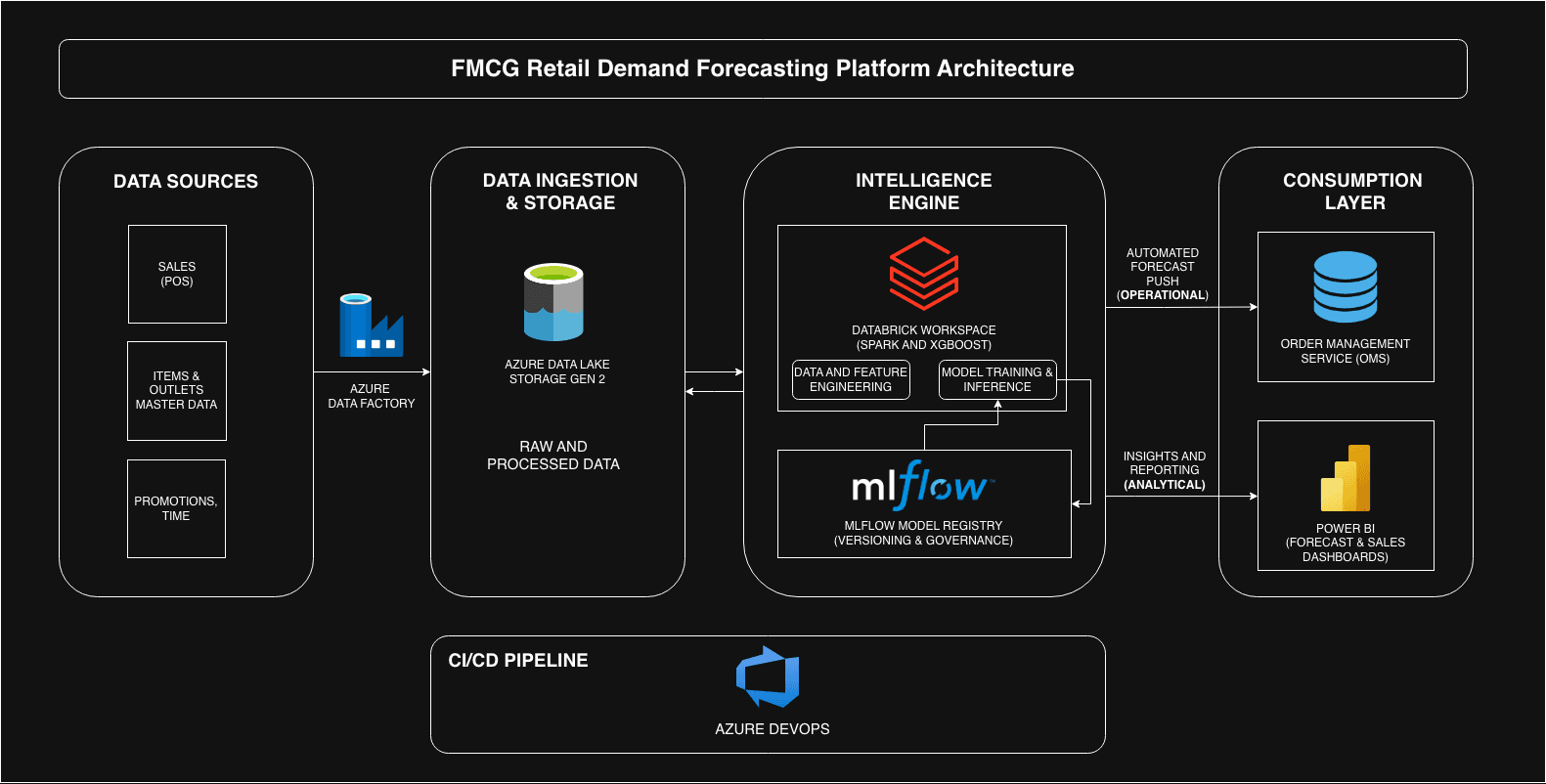
1The Problem
A large FMCG retailer lacked a reliable forecasting system to support inventory planning and promotion execution across thousands of SKUs and outlets. The existing process failed to properly separate baseline demand, seasonal effects, and promotional uplift. This resulted in: - Frequent stock-outs during promotions leading to lost sales - Excess inventory for slow-moving items increasing holding costs - Heavy manual effort during promotion cycles - Poor inventory balance across the network The business needed an enterprise-grade forecasting solution that could operate at multiple granularities and support different decision points in the supply chain.
2The Approach
I designed a modular machine learning forecasting system that separates demand into baseline, promotional uplift, and uncertainty buffers. Key decisions: - Use XGBoost for its ability to model non-linear demand patterns and handle mixed feature types - Build a single global model across item × outlet combinations to improve generalization - Introduce multi-horizon forecasting aligned with supply chain decision timelines - Replace static safety stock rules with error-driven buffer calculations - Automate the full pipeline from data ingestion to order management system integration
Technical Architecture
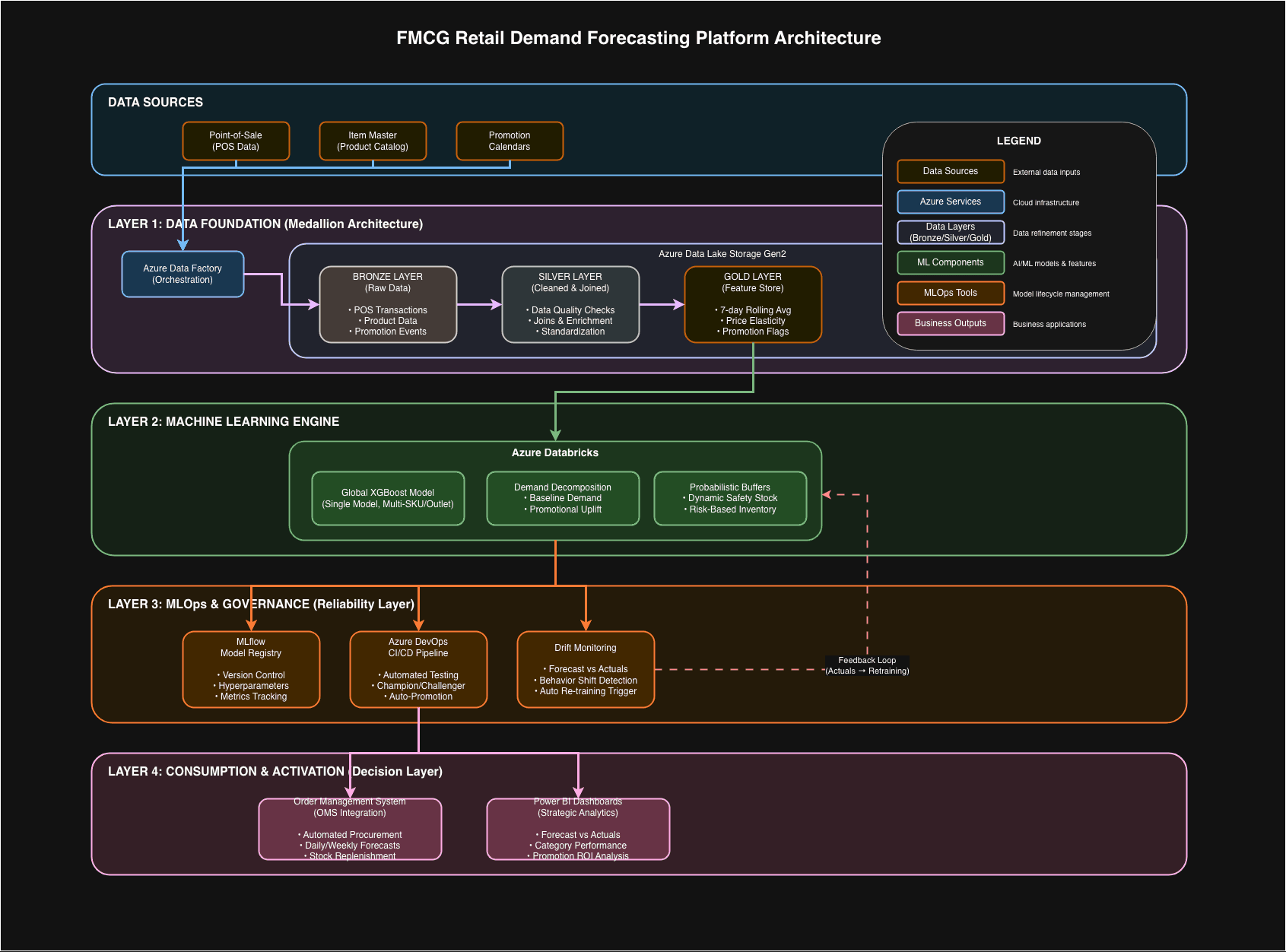
Data Layer: Aggregated transactional sales, item hierarchy, outlet features, and promotion data
Feature Engineering Layer: Time features, seasonality signals, promotion attributes, and historical trends
Baseline Forecasting Model: Predicts natural demand excluding promotions (weekly forecasts W+1 to W+7)
Promotion Uplift Model: Estimates incremental demand impact at multiple planning stages (13 to 2 weeks prior)
Buffer Calculation Layer: Computes safety stock dynamically using historical forecast errors
Forecast Disaggregation Layer: Converts weekly predictions to daily item–outlet level outputs
Automation Pipeline: End-to-end pipeline from data extraction to order management system integration
Monitoring Layer: Power BI dashboards for tracking forecast trends and performance
Results
Improved promotion forecasting accuracy by 8–10% over existing methods
Reduced stock-outs during promotional periods
Minimized excess inventory for slow-moving items
Significantly reduced manual effort in promotion planning cycles
Enabled scalable forecasting across 6000+ SKUs and 130+ outlets
Key Insights
“Separating baseline demand and promotional uplift significantly improves forecast accuracy in retail systems”
“Global models outperform per-item models by leveraging shared demand patterns across outlets”
“Error-driven buffer calculations are more effective than static safety stock rules”
“Explainability is critical for adoption in supply chain and business teams”
Tech Stack
Interested in a similar project?
I'd love to discuss how we can apply this kind of approach to your specific business challenge.
Let's Talk